Stories · Morocco
What a Friday Family Lunch Taught Me About Generosity
A composite story from a Maghreb Friday: couscous after prayers, three generations at one table, and why refusing dessert was the hardest thing on the menu.
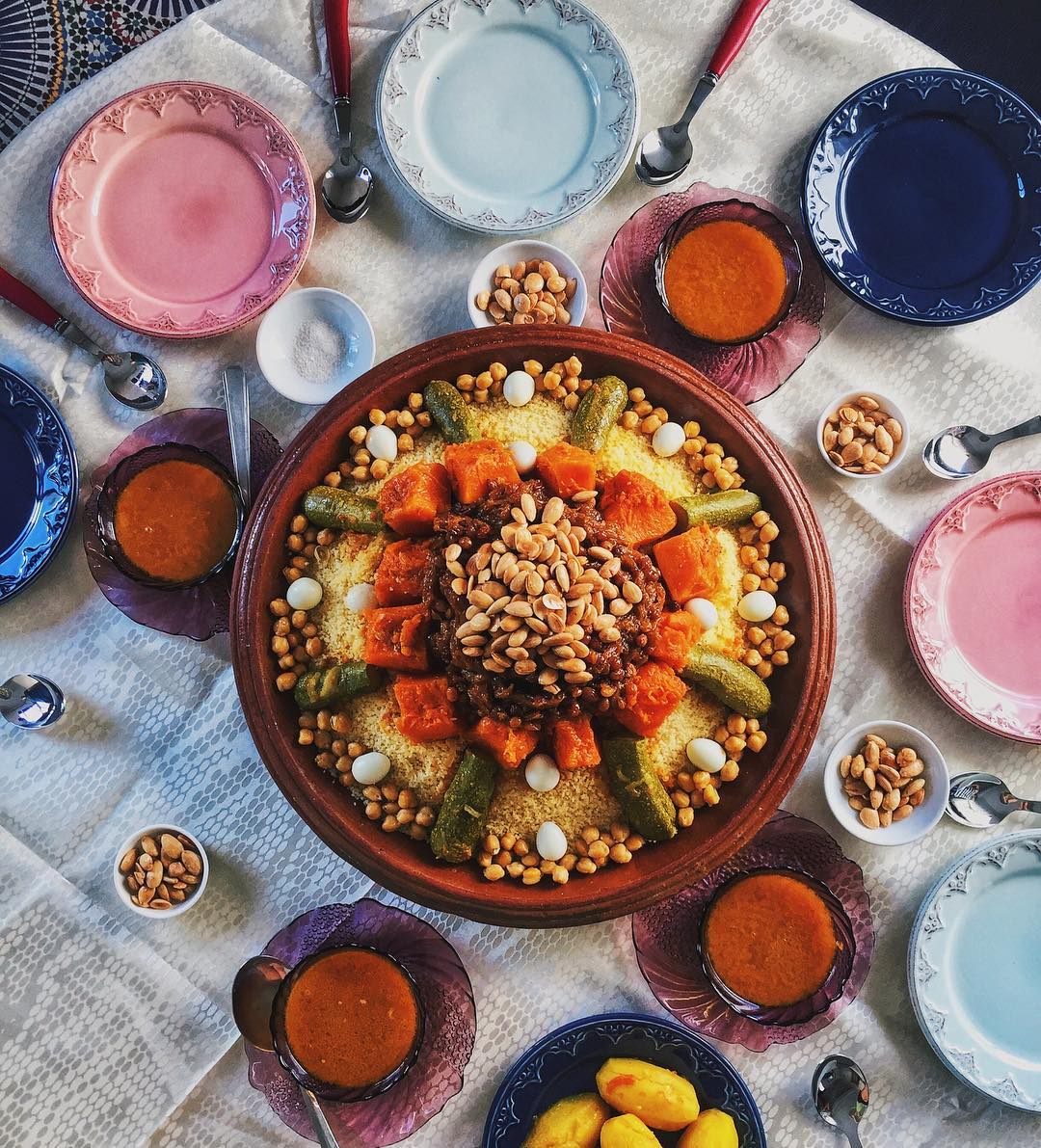
A note from the editors: this is a sample story, like our first one from Yazd — published to show the shape of the Stories section while the site is new. It is a composite drawn from documented accounts and well-attested custom, not a first-hand report. The facts about Friday and couscous are accurate and sourced below; the family is a device, and a grateful one.
Friday in the old city begins with a sound: the mosque’s call to prayer rolling through the alleys in overlapping waves, one minaret starting before the last has finished, until the whole medina is humming. Shops close early. Men walk toward prayer in long, loose shifts of white and grey. And in every kitchen in the city, something has been steaming since mid-morning.
Couscous. Not the five-minute sort. The kind UNESCO inscribed on its Intangible Cultural Heritage list in 2020 — the joint nomination of Algeria, Mauritania, Morocco and Tunisia — where the semolina is rolled by hand, steamed over the broth three separate times, and the whole process is described in the inscription itself as linked to “solidarity, conviviality, sharing meals and togetherness.”
I was there because of a bread mistake.
Three days earlier, standing bewildered in front of a communal ferran — the neighbourhood wood-fired oven where families bring their dough each morning — I had accidentally taken someone else’s loaf. Identical boards, identical bread. The owner of the bread, a woman in her sixties with flour still on her sleeves, had watched me realize it and laughed until she had to sit down on the step. Then she told me, in French, that tomorrow I should come back and she would show me how it worked properly.
Tomorrow became three tomorrows. On the third one she said: “Friday, you come to the house. One o’clock. You will eat couscous.”
I said something polite about not wanting to intrude. She looked at me the way you look at a child who has said something charmingly wrong. “Friday,” she repeated, and walked home.
Here is what I understood later: on Friday, the table is not allowed to be for the family only. The word for the meal’s logic isn’t dinner party — it’s closer to open. A neighbour’s child, a cousin passing through, a stranger from the bakery queue: there is always room, because the dish was built in quantities that assume the room. UNESCO’s inscription notes that couscous is served for “weddings, funerals, and the return of someone from abroad” — in other words, for exactly the moments when a household’s circle suddenly widens.
Lunch lasted four hours. There was a first couscous with vegetables, and later — as if the kitchen were simply showing off now — a second, sweeter one, with raisins and cinnamon. There was a baby passed around the table like a shared dish. There was an argument about football that resolved into tea. And there was the moment I tried, stumbling through my best French, to thank the grandmother for the meal.
She waved the thanks away and delivered the sentence I’ve thought about more than any other on this project:
“You don’t thank someone for Friday. You come back next Friday.”
I have no recipe for you, and no tip. Only this: if a door opens on a Friday — in Fes or Tunis or Algiers or Marrakech — walk through it. The dish on the table was inscribed by four governments as a monument to sharing. You are not imposing. You are, in the most literal sense UNESCO intended, part of the heritage.
And learn the word b’sahha — “to your health,” said to the cook. It travels further than any thank-you I know.