Routes · Tunisia
Tunisia in Ten Days: Carthage, Kairouan, Dougga, Djerba
Seven UNESCO World Heritage sites, three thousand years of history, and a country the size of England. A ten-day route that skips the resort strip entirely.
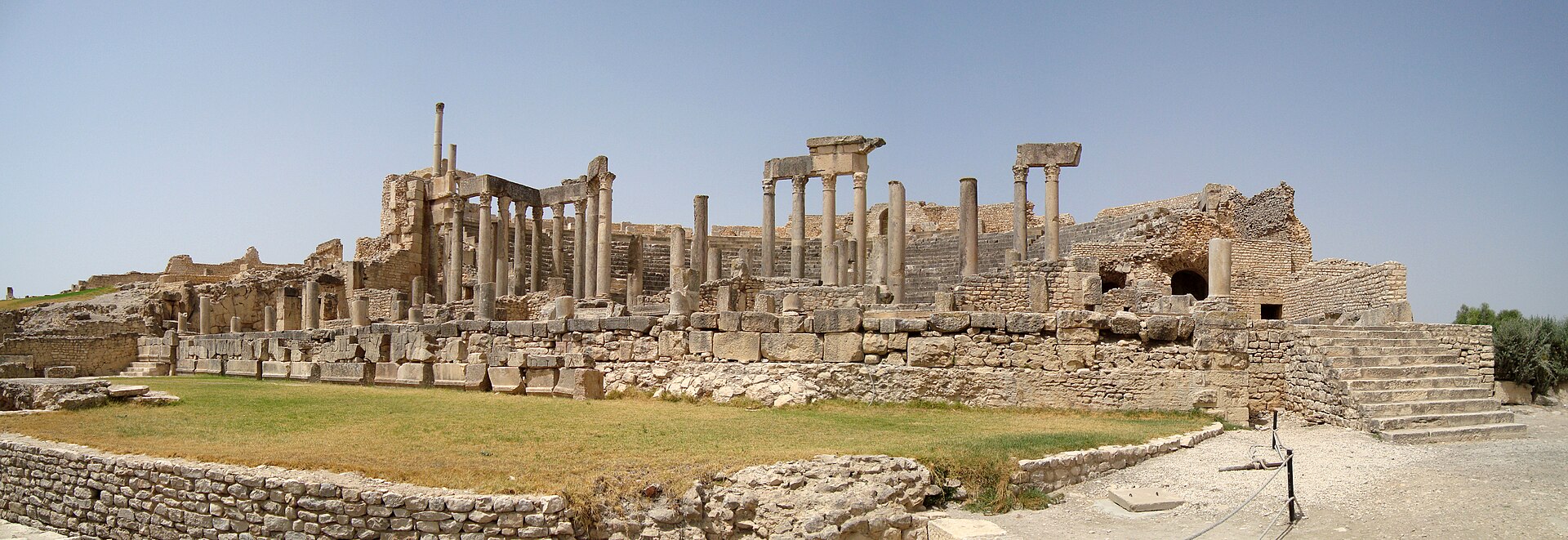
Tunisia is the most underrated country in the Mediterranean basin, and the reason is structural: it has Roman cities as good as anything in Italy, an Islamic holy city older than most of the Maghreb’s, and a coastline that package tourism has spent forty years hiding. Ten UNESCO World Heritage sites sit inside a country you can drive the length of in a day.
Ten days, no resort strip, no rush.
Days 1–2: Tunis and Carthage
Start in the Medina of Tunis (inscribed 1979) — not the wide French colonial boulevard but the old city behind it: the Zitouna Mosque, the souqs grouped by trade, the Dar Ben Abdallah palace museum for domestic life. An hour’s walk from the medina gets you to the Bardo, which holds the world’s finest collection of Roman mosaics. That is not a marketing claim; go and test it.
Day 2 is Carthage (1979). Manage expectations: the ancient city is now a scatter of sites across a wealthy suburb, and the Romans levelled what the Carthaginians built. What remains — the Antonine baths, the Byrsa hill, the Punic ports — is genuinely moving if you arrive knowing the story. The Carthage Museum on Byrsa sets it up properly.
Do Sidi Bou Saïd at sunset — and note that since July 2026 it is no longer merely the pretty hill at the edge of Carthage’s listing. At the 48th session in Busan it was inscribed in its own right, as a centre of cultural and spiritual inspiration, making Tunisia’s tenth World Heritage site. The village grew around the tomb of Abu Said al-Baji, a 13th-century Sufi scholar; the cobbled lane, the indigo doors and the Café des Nattes are the same, but the stakes are different. Arrive before 9am or after 4pm — it is compact and crowded in between.
Day 3: Kerkouane
A detour north-east that almost nobody makes: Kerkouane (1985), a Punic town abandoned after the fall of Carthage and never rebuilt over. You walk the ground plan of a 2,300-year-old city — houses with bath tubs cut into the floor, a dye works, streets. It is quiet, unguarded by scaffolding, and the most direct contact with Punic daily life anywhere.
Days 4–5: Kairouan
Kairouan (1988) is the fourth holiest city of Islam after Mecca, Medina and Jerusalem, founded in 670, and the first great capital of the Maghreb. The Great Mosque’s square minaret is the oldest in the world still standing; the Aghlabid basins outside town are ninth-century water engineering of a scale that makes the term “cistern” feel inadequate.
Two nights here, not one. Walk the medina at dawn, buy makroudh (the semolina-and-date sweet the city is known for), and visit the mosque outside prayer times.
Day 6: El Jem
El Jem’s amphitheatre (1979) is the third-largest in the Roman world after the Colosseum and Capua’s — and unlike the Colosseum, you can walk into the arena and down into the gladiators’ corridors without a crowd. The mosaic museum opposite holds some of the best floor mosaics in Africa.
Day 7: Sousse
Sousse’s medina (1988) is a working port town’s old quarter rather than a monument — ribat, Great Mosque, walls, and a catacomb complex that is genuinely eerie. It is the most “liveable” of the Tunisian medinas, which makes it a good place to slow down.
Days 8–9: Djerba
Djerba (inscribed 2023) is the newest Tunisian listing and the one most people misjudge. The island’s heritage is not its beaches — it is the human settlement pattern: a low-density landscape of dispersed villages, fortified farmsteads (menzels), mosques of unusual design, and the El Ghriba synagogue, one of the oldest in the world and still in use. Houmt Souk’s market and the ceramic village of Guellala fill a day. The lagoon of flamingos fills another in winter.
Day 10: Dougga (or an extra day in Tunis)
Dougga / Thugga (1997) is the best-preserved Roman small town in North Africa — theatre, Capitol, temples, houses, on a hillside above olive groves, with almost no visitors. It is two hours west of Tunis by car, which makes it an awkward last day unless you fly out late. If you can, take a driver for the day and come back through Testour’s Andalusian quarter.
Practical notes
- Season. October to April. July and August are punishing inland (Kairouan hits 40°C).
- Transport. Louages (shared minibuses) connect every town, are cheap and fast, and drop you where you need to be. Trains link Tunis, Sousse and Sfax comfortably.
- Language. French is the working second language; Arabic the first. English is patchy outside tourist areas, which makes a phrasebook less useful than basic French.
- Money. Cash is king outside Tunis and Djerba. ATMs exist in every town but fail often.
- Ramadan. Restaurant hours collapse at midday and the mood shifts after sunset — worth experiencing once, but plan around it if you want to move fast.
Tunisia rewards the traveller who treats it as a country rather than a beach. Ten days, ten World Heritage sites, three thousand years of Mediterranean history — and you will still leave one unvisited.
Frequently asked questions
How many UNESCO World Heritage sites does Tunisia have?
Ten, as of July 2026. The list runs: Medina of Tunis, Archaeological Site of Carthage, Amphitheatre of El Jem, Ichkeul National Park, Punic Town of Kerkuane, Kairouan, Medina of Sousse, Dougga/Thugga, Djerba, and — inscribed at the 48th session in Busan in July 2026 — the village of Sidi Bou Saïd, which previously sat inside Carthage's boundary and now has its own listing.
Is it safe to travel Tunisia independently?
Yes, on the standard tourist circuits — Tunis, Carthage, Kairouan, Sousse, Djerba and the southern oases. Check your own government's advisory for border regions with Algeria and Libya, which are separately restricted, and avoid remote desert tracks without a guide.
Do I need a car?
No. Tunis to Kairouan, Sousse and Sfax are served by louages (shared minibuses) and trains; Djerba has an airport. Dougga and Kerkouane are easiest with a hired car and driver for a day. Driving standards are lively, so hiring a car with a driver is often the better deal.