Routes · Uzbekistan
The Silk Road Triangle: Tashkent, Samarkand, Bukhara, Khiva
Uzbekistan's four cities on one high-speed rail line, plus how to add Khiva and Shahrisabz — with real train times, city-night counts, and the visa situation.
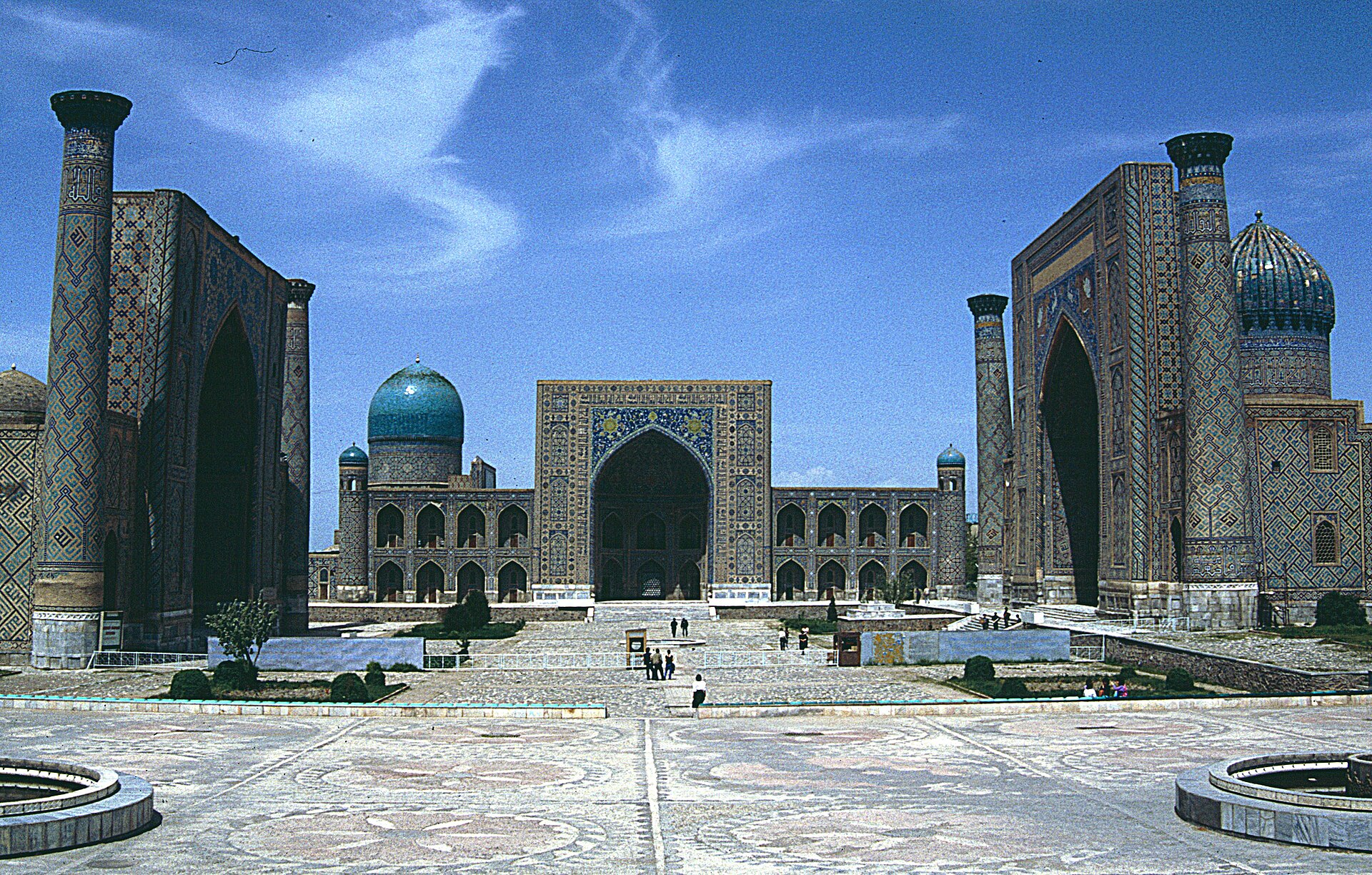
Uzbekistan is the rare country where the classic route is also the best one, because the rail network does the work for you. Four cities, one high-speed line, and a World Heritage list that covers each stop. Here is the route with actual train times, how many nights each city deserves, and how to handle the one awkward leg.
A note on timings: train durations below reflect the Afrosiyob high-speed service. Confirm schedules when you book — services have been expanded year on year, and not every city pair runs daily.
The triangle at a glance
| Leg | Approx. time | Mode |
|---|---|---|
| Tashkent → Samarkand | 2 h 10 m | Afrosiyob high-speed train |
| Samarkand → Bukhara | 1 h 40 m | Afrosiyob or Sharq train |
| Bukhara → Khiva | 6–7 h | Train (slower) or shared taxi (~5 h) |
| Khiva → Urgench | 30–40 m | Road |
| Urgench → Tashkent | 1 h 30 m | Flight |
The Uzbekistan leg is the route’s only real friction point. The comfortable answer is: train or drive from Bukhara to Khiva, then fly out from Urgench airport rather than retracing the desert road.
Tashkent — 2 nights
Tashkent is the least romantic stop and the most useful one. It has the best hotels, the money changers, the SIM cards, and two things actually worth your time: the Hazrati Imam complex (which holds one of the world’s oldest surviving Qur’ans) and the metro, whose Soviet-era stations are decorated with such ambition that riding the system is a legitimate sightseeing activity.
Two nights. Arrive, adjust, buy train tickets, and see the metro.
Samarkand — 3 nights
Inscribed 2001 as “Crossroad of Cultures,” and the single most impressive stop on the route. The plan:
- Day 1: The Registan at opening, then the bazaar behind Bibi-Khanym Mosque.
- Day 2: Gur-e Amir (Timur’s tomb), then Shah-i-Zinda — the lane of tiled mausoleums — late in the afternoon when the crowds thin.
- Day 3: Afrasiyab (the original Sogdian city and its astonishing 7th-century murals) and Ulugh Beg’s observatory, then the Registan again after dark.
Do not skip Afrasiyab. It is the oldest layer of the city and the site almost every visitor skips.
Bukhara — 2–3 nights
Inscribed 1993, and the most satisfying city to walk, because the historic centre is compact and largely intact. The Ark Fortress, the Poi Kalyan complex, the Chor Minor (the four-towered gatehouse made famous on a guidebook cover), and the Samanid mausoleum — a brickwork masterpiece over a thousand years old — are all within walking distance of each other.
Bukhara is also the place to slow down: hammams, tea houses, and a bazaar that hasn’t been entirely converted into souvenir stalls. Give it three nights if you can.
Khiva — 2 nights
Itchan Kala, Khiva’s walled inner city, was Uzbekistan’s first World Heritage site — inscribed as far back as 1990. This is the great reward and the great debate: Khiva has been restored so thoroughly that some travellers find it too polished, more open-air museum than living town. Go anyway, and go at dawn.
Two nights is right: one to walk the walls at sunset, one to have the place to yourself at sunrise. Stay inside the walls if you can afford it.
Shahrisabz — optional, 1 day
Inscribed 2000, and on the List of World Heritage in Danger since 2016 because of over-development around the site. It was Timur’s birthplace and summer capital, and the Ak-Saray palace remains stand as fragments of something colossal. It’s 2 hours south of Samarkand by road — a day trip, and a sobering one about how heritage sites can be damaged by the pressure of visitors.
Suggested 10-day shape
| Day | Where |
|---|---|
| 1 | Arrive Tashkent |
| 2 | Tashkent → Samarkand (high-speed) |
| 3–4 | Samarkand |
| 5 | Samarkand → Bukhara |
| 6–7 | Bukhara |
| 8 | Bukhara → Khiva |
| 9 | Khiva |
| 10 | Khiva → Urgench → fly out |
Practical essentials
- Book trains a few days ahead in high season (April–May, September–October). The Afrosiyob sells out.
- Cash is still king outside hotels. ATMs exist in the big cities and are not always reliable; bring a reserve.
- Russian is the practical second language everywhere; English is common among people under 30 in tourism.
- Dress modestly in religious sites. No headscarf is required for women in Uzbekistan, unlike in Iran.
- Don’t combine it with Turkmenistan on a whim. Transit visas there are genuinely difficult and route planning around them is a project of its own.
The verdict
Uzbekistan’s four cities are a single, coherent, and unusually comfortable trip: one fast train line, four World Heritage stopovers, and a food culture (plov, above all) that makes the travel days worth it. The only decision is whether to push west to Khiva — and you should.
Frequently asked questions
How many days do you need in Uzbekistan?
Ten days is a comfortable minimum for Tashkent, Samarkand, Bukhara and Khiva. Seven days is possible if you skip Tashkent's museums and fly between Samarkand and Urgench.
Do I need a visa for Uzbekistan?
Most Western nationalities currently enter visa-free for 30 days, and an e-visa covers many others. Policy has been liberalised repeatedly since 2018, so verify the current rule before booking.
Is Khiva worth the long journey?
Yes, with a caveat: the trip west is a flight and a drive, or a long shared taxi. In exchange you get Itchan Kala — Uzbekistan's first World Heritage site (1990) and the most completely preserved walled inner city in Central Asia.