Destinations · Yemen
Zabid: The Town That Taught the Islamic World
For centuries, Zabid on Yemen's Red Sea coast was home to one of the most important centres of learning in the Islamic world — a university town of mosques, madrasas and 40,000 inhabitants.
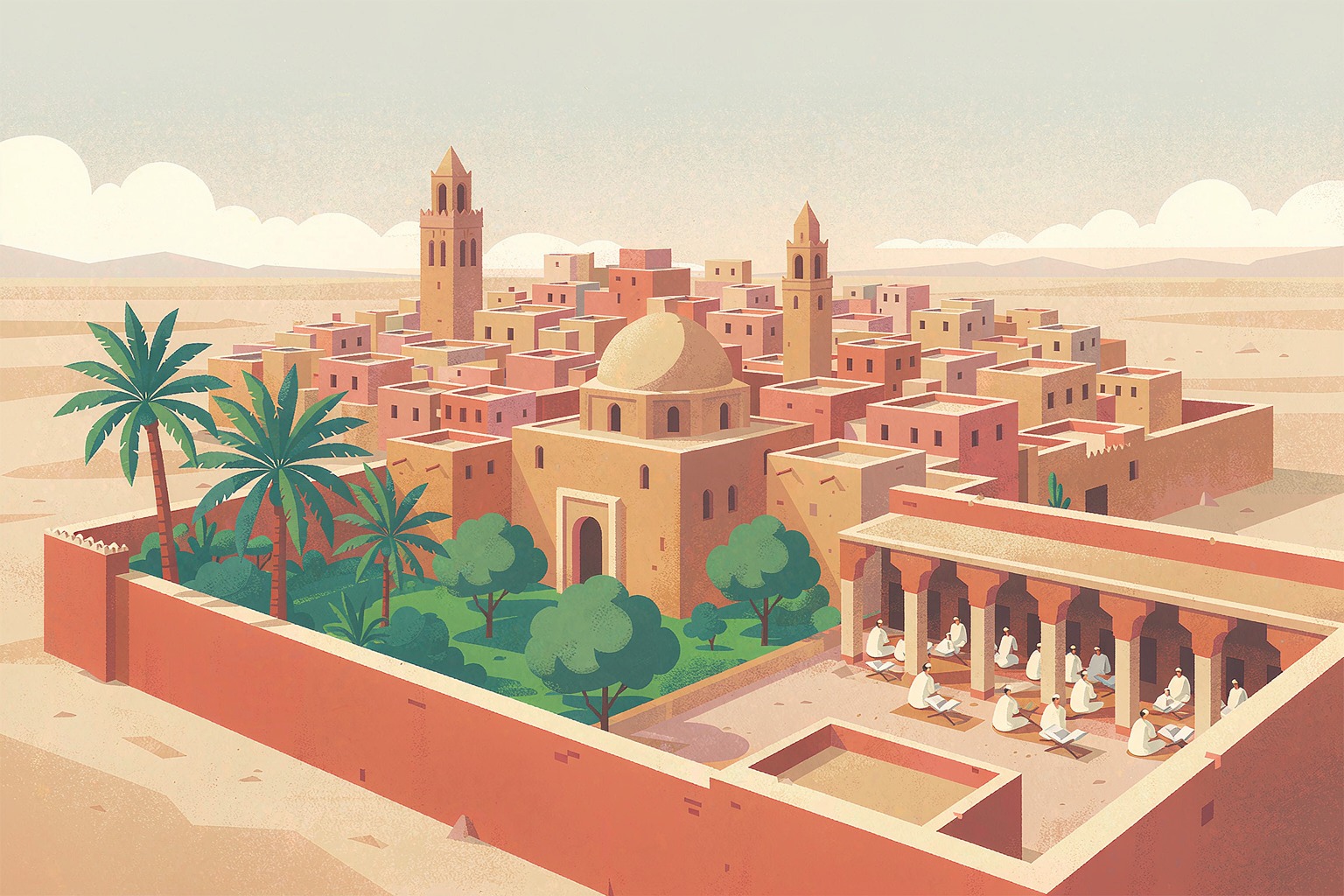
Before there was a modern university campus, there was the mosque university — a town where the whole urban fabric existed to house students, teachers, books and the argument between them. On the flat coastal plain of western Yemen, the best example was Zabid.
Between the 13th and 15th centuries, Zabid was one of the great intellectual centres of the Islamic world. At its height it housed around 40,000 people — an enormous town by the standards of the day — and its scholars were known from Cairo to Delhi. UNESCO inscribed the Historic Town of Zabid in 1993 (site 611).
A university without a campus
There was no single building called “the university”. Teaching happened in mosques and madrasas across the town, with a professor attached to a particular mosque and students following him from one to another. The urban fabric was the institution:
- The Great Mosque and its courtyard, teaching space and legal instruction.
- Dozens of smaller mosques and madrasas, each a node in the teaching network.
- The citadel, administrative and defensive heart of a town whose wealth came from trade through its port.
The famous Egyptian traveller Ibn Battuta passed through in the 14th century and described a place of scholars and piety; later accounts speak of students arriving from Indonesia and West Africa. The town’s curriculum travelled further than its buildings.
Why the mud mattered
Zabid’s architecture is deliberately modest — flat-roofed mud-brick houses, a dense pattern of courtyards and lanes, no tall towers. On the Tihama coastal plain the challenge is heat and humidity rather than defence, so the town spread outward instead of upward, its courtyards catching whatever breeze came off the Red Sea.
This is what makes Zabid the exact opposite of Shibam, 600 km east: two Yemeni towns, two intelligent responses to two climates, both made of the same earth.
A place being lost
UNESCO put Zabid on the List of World Heritage in Danger in 2000. Its mud-brick fabric is disappearing — not in a single catastrophe but by replacement: a concrete house goes up where a madrasa stood, a mosque is rebuilt in modern materials, a lane widens into a road. The university’s living tradition survived longer than its buildings, but both are now under pressure.
As with Sana’a and Shibam, travel to Yemen is currently advised against by Western governments. The guide is a record, not a recommendation — a reminder that a town which taught much of the region once stood on this flat, hot plain.
Frequently asked questions
Why was Zabid important?
From the 13th to the 15th centuries Zabid's university was one of the main centres of learning in the Islamic world, particularly for law, theology and Arabic linguistics. Students came from across the region; the town's fabric — mosques, madrasas, a citadel — grew around that scholarly function.
Where is Zabid?
On Yemen's western coastal plain, roughly 100 km south of Al Hudaydah, near the Red Sea. Its flat mud-brick town contrasts sharply with the tower houses of the Hadramaut inland.
What is its current state?
UNESCO placed Zabid on the List of World Heritage in Danger in 2000. Much of the historic fabric has been replaced by modern concrete buildings, and conservation is severely constrained by the ongoing conflict. Travel is advised against by all Western governments.