Destinations · Iran
Yazd: The Desert City That Kept Its Windcatchers
Badgirs, qanats and mud-brick walls a metre thick: how Yazd engineered a comfortable city in the Iranian desert, and why UNESCO called it a living example.
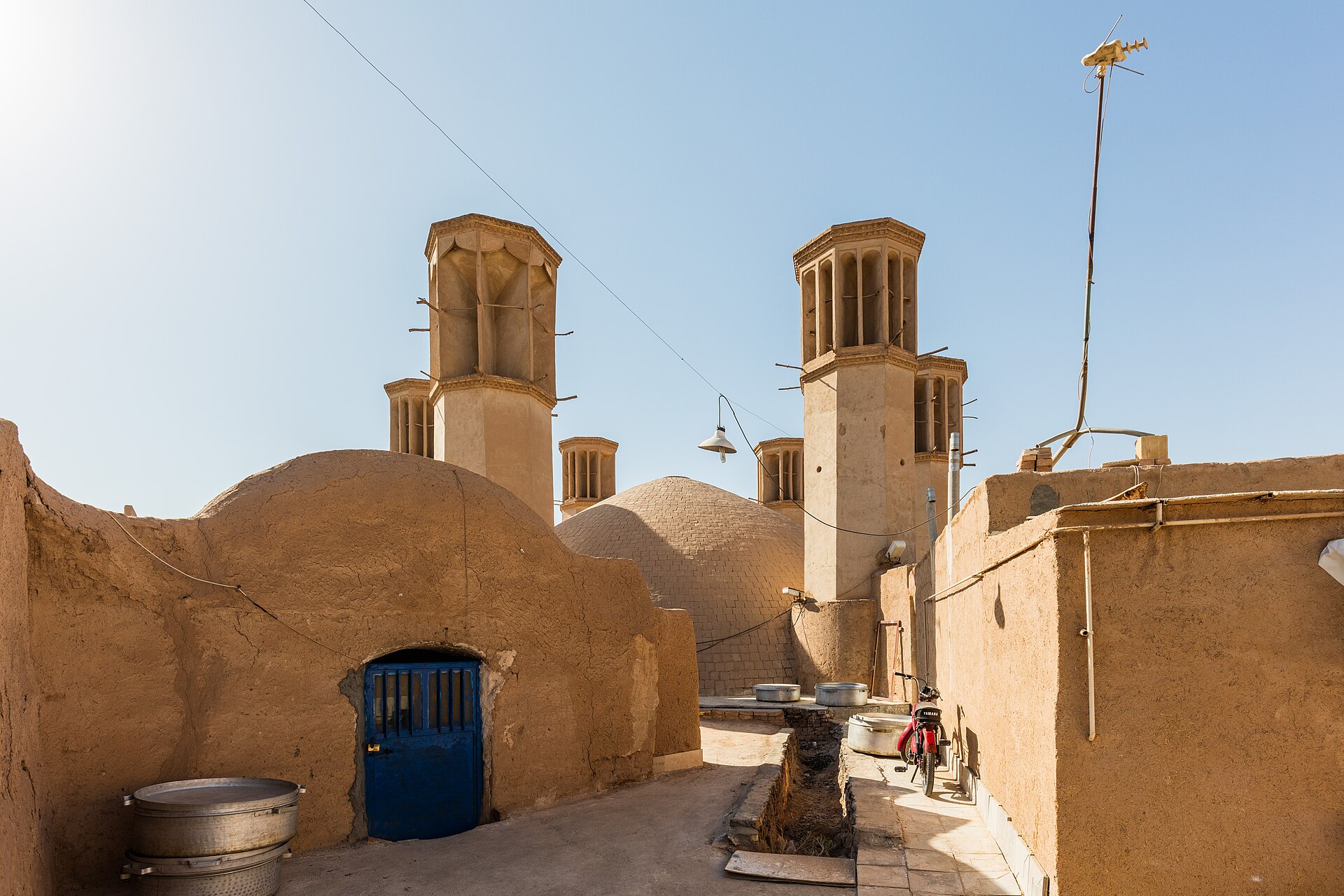
Most desert cities are remembered for what they lost. Yazd is remarkable for what it kept: an entire cooling system, functioning, above ground and below, in a city that UNESCO inscribed in 2017 as a living example of desert architecture rather than a ruin of one.
The badgir, explained properly
The word is usually translated “windcatcher,” which undersells it. A badgir is a passive air conditioning stack: a tower with vertical louvred openings on two, four or even eight faces, channelling moving air down an internal shaft and into the room beneath. The warm air it displaces rises and exits through the opposite face.
The elegant part is that it works even without wind. The tower’s interior stays cooler than the street, so convection alone draws air down; and the tower’s height means it draws from cleaner, faster air above the rooftops. In the tallest examples — the six-tower Shesh Badgir on the edge of the old city is the famous one — the effect is a steady, dry breeze in a courtyard that would otherwise be a furnace.
Add to that mud-brick walls sometimes a metre thick (thermal mass slows the daily heat cycle by hours), high narrow alleys that stay in shadow most of the day, and domed roofs that shed heat, and you have a complete climate strategy built from earth and wind, with no moving parts.
Under the city: the qanats
Above ground, wind. Below, water. Yazd is fed by qanats — gently sloping underground channels that carry groundwater from the mountains by gravity alone, sometimes over tens of kilometres. Every few dozen metres a vertical shaft breaks the surface, both for maintenance and for ventilation; from the air these shafts look like a line of craters marching across the desert.
The Persian qanat system was inscribed by UNESCO in 2016, and Yazd’s are among its best-known elements. Some have been running for more than two thousand years — the definition of sustainable infrastructure, if you accept that “sustainable” means lasting longer than most countries.
What to see, in order of payoff
- The old city at rooftop level — climb one of the rooftop cafés around the Jameh Mosque at sunset. The forest of badgirs and domes, lit gold, is the photograph you came for.
- Jameh Mosque of Yazd — the portal’s tilework is among the finest in Iran, and the minarets are the tallest in the country.
- Dolat Abad Garden — a Qajar-era walled garden with the tallest windcatcher in the city, combined with water channels; UNESCO listed it as a Persian Garden in 2011.
- Water Museum — set in a restored merchant house that sits over a qanat branch you can walk into. The best single explanation of the system in the city.
- Fire Temple (Atashkadeh) — the sacred fire is said to have burned since the Sassanid period; Yazd remains the centre of Iran’s Zoroastrian community.
- Towers of Silence — outside town, on two rocky hills, the Zoroastrian burial structures. Visit with respect: this is a religious site, and the community still uses the area.
- Amir Chakhmaq Complex — the triple-storey facade and its sunken tekyeh are the city’s other postcard.
Practical, without the romance
- Stay in the old city, in a restored merchant house — many have courtyard rooms and rooftop terraces, and the whole point of Yazd is evening light on mud brick.
- Get lost in the alleys deliberately. They are safe, mostly shaded, and end in courtyards, bakeries and workshops that no itinerary predicts.
- Dress code applies as everywhere in Iran — headscarf and loose clothing for women, long trousers for men. In Yazd the practical version, in 40°C, is light cotton.
- Water: drink far more than you think. The city’s architecture is dry by design, and so is the air.
- Getting there: overnight train or bus from Tehran, or a domestic flight. Yazd sits between Isfahan and Kerman, so it slots naturally into a central-Iran route.
The conceit of most heritage cities is that they stopped working centuries ago. Yazd’s towers still move air, its channels still move water, and its alleys are still the right shape for the sun. That is what “living” means in UNESCO’s citation — and the reason the city feels less like a monument than like a machine someone is still operating.
Frequently asked questions
How do Yazd's windcatchers work?
A badgir is a tall tower with vertical openings facing different directions. Wind entering the upwind face is funnelled down a shaft into the room below; warm air is drawn up and out through the opposite side. Towers also work without wind, using the pressure difference between the hot exterior and the cooler interior. Height matters — a few extra metres of tower catch more breeze and cleaner air.
What is a qanat?
A gently sloping underground channel that carries water from an aquifer at the foot of the mountains to the town, by gravity alone. Vertical shafts every few dozen metres allow maintenance and ventilation. Yazd province's qanats are part of the 2016 UNESCO listing for the Persian qanat system, and some have run for over two thousand years.
When is the best time to visit Yazd?
March to May and September to November. Summer temperatures in Yazd regularly exceed 40°C, and the city's architecture is designed for that heat but tourism in it is not. Winter days are mild, nights cold.