Destinations · Tunisia
Tunisia: Ten World Heritage Sites Most Travellers Have Never Heard Of
Tunisia has ten UNESCO World Heritage properties — more than Egypt. Carthage, the medinas of Tunis and Sousse, the amphitheatre at El Jem, the Roman city of Dougga, and a new listing added in 2026. Here is how to see them properly.
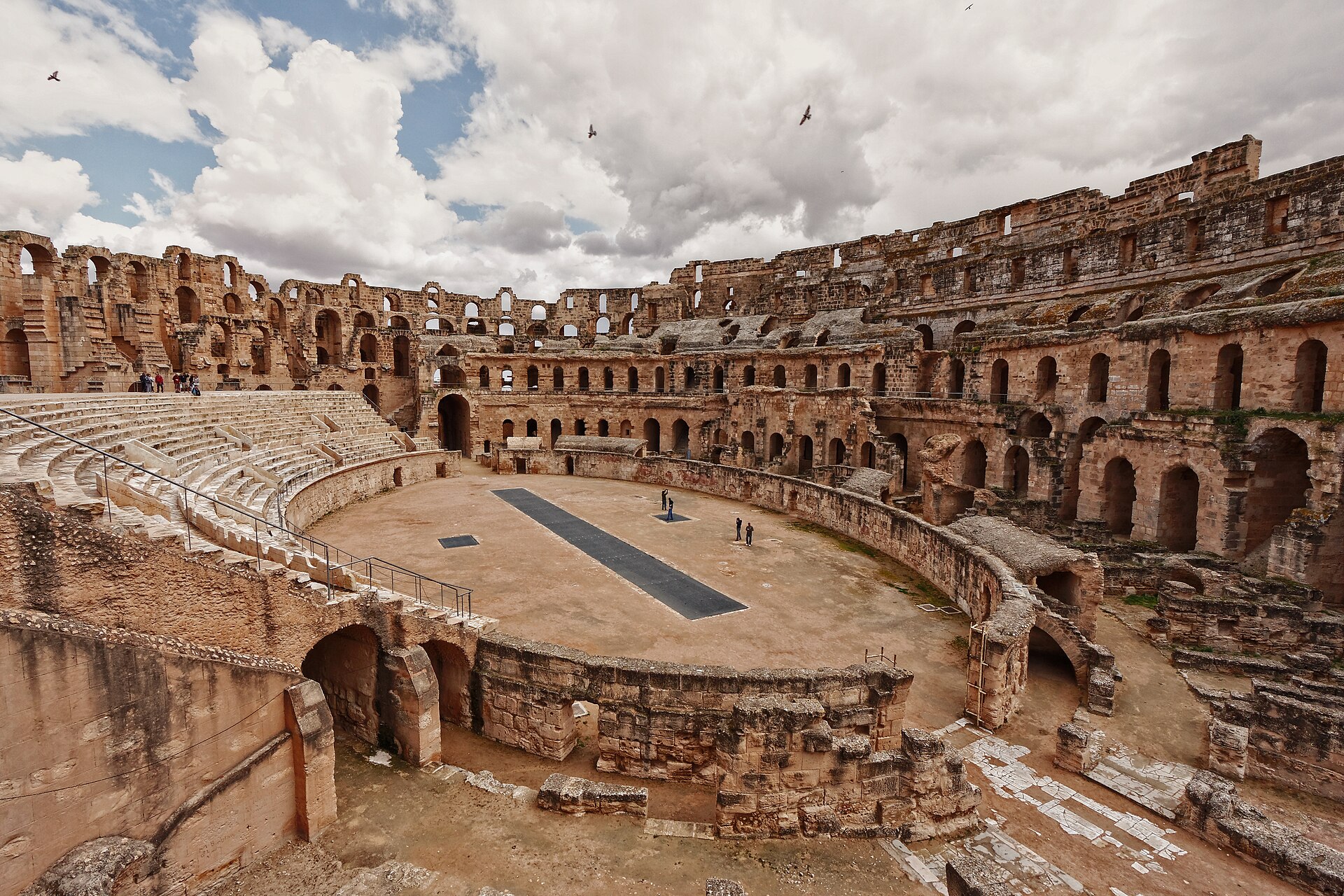
Tunisia has ten UNESCO World Heritage properties. Egypt, its neighbour and the country that dominates the region’s tourism, has seven. Almost nobody knows this, and the practical consequence is that you can stand in the middle of a Roman city that rivals anything in Italy and be the only person there.
Here is the country’s list, and how to see it.
The full list
| Property | Inscribed | Type |
|---|---|---|
| Ichkeul National Park | 1980 | Natural |
| Amphitheatre of El Jem | 1979 | Cultural |
| Archaeological Site of Carthage | 1979 | Cultural |
| Medina of Tunis | 1979 | Cultural |
| Punic Town of Kerkuane and its Necropolis | 1985, 1986 | Cultural |
| Kairouan | 1988 | Cultural |
| Medina of Sousse | 1988 | Cultural |
| Dougga / Thugga | 1997 | Cultural |
| Djerba: Testimony to a settlement pattern in an island territory | 2023 | Cultural |
| Village of Sidi Bou Saïd | 2026 | Cultural |
Two things stand out. First, the 1979 inscription of three properties at once — Carthage, the Medina of Tunis and El Jem — which marks Tunisia as one of the earliest and most enthusiastic participants in the convention. Second, the 2026 addition of Sidi Bou Saïd, which means the country’s list is still actively growing.
Tunis and Carthage: the base
Carthage was inscribed in 1979 (reference No. 37) and is a problem for visitors expecting a monument. It was destroyed by Rome in 146 BC, rebuilt as a Roman city, and has since been quarried, built over, and spread across a large suburban area of modern Tunis. There is no single ruin to photograph.
What there is: the Antonine Baths on the waterfront, the Punic ports, the sanctuary of Tophet, the Roman villas on the hill of Byrsa, and a museum that ties it together. Do the museum first, then the sites, or the archaeology will read as scattered foundations.
Getting there is straightforward. The TGM suburban rail line runs from central Tunis along the coast to Carthage and onward to Sidi Bou Saïd — one ticket, twenty to forty minutes, and the cheapest sightseeing route in the country.
Sidi Bou Saïd, newly inscribed in 2026, is the village at the end of that line: whitewashed houses, blue doors and window grilles, steep lanes, and a café culture built around a view of the Gulf of Tunis. It is extremely popular and correspondingly crowded in high season — go on a weekday morning, or stay overnight when the day-trippers leave.
The Medina of Tunis (inscribed 1979, reference No. 36) is the other half of the base. It is a functioning medina, not a museum: around 700 historic monuments — palaces, mosques, madrasas, fountains, souqs — inside a dense urban fabric. Enter through Bab el Bhar and walk north; the souqs specialise by trade, and the further in you go, the less the goods are aimed at visitors.
Do not miss the Bardo Museum, outside the medina. Its mosaic collection is one of the most important in the world, and it is the single best preparation for understanding what you are walking over in every other Tunisian site.
El Jem: the amphitheatre
The Amphitheatre of El Jem, inscribed in 1979, is one of the largest Roman amphitheatres ever built — comparable in capacity to the Colosseum — and it stands almost free of later construction, in a small inland town.
It is the most immediately impressive ancient monument in the country. You can walk the tiers, descend into the basement where animals and gladiators were held, and see the whole structure at once from the upper rows. It is a ninety-minute drive from Sousse, and entirely worth a dedicated trip.
Kairouan: the fourth holy city
Kairouan was inscribed in 1988 and is, for many Muslims, the fourth holiest city of Islam after Mecca, Medina and Jerusalem. Founded in the seventh century, it was the first capital of the Muslim west.
What to see:
- The Great Mosque of Uqba — one of the oldest and most important mosques in the world, and the model for much of what was built afterwards across the Maghreb.
- The Medina with its bazaars, particularly the carpet market. Kairouan carpets are a genuine local craft with a distinctive style; buy from a workshop, and expect to be shown many variations before you find one.
- The basins — the great Aghlabid reservoirs outside the walls, built in the ninth century to supply the city with water.
Kairouan is about two hours by road from Tunis or Sousse, and pairs naturally with either.
The two that nobody visits
Dougga (Thugga), inscribed in 1997, is widely described as the best-preserved Roman small town in North Africa, on a hillside in the north-west with almost nothing around it. It has a theatre, temples, baths, and the Libyo-Punic mausoleum — a pre-Roman monument that survived because it was incorporated into later building. On a weekday you may have the site to yourself.
Kerkuane, inscribed in 1985 and 1986, is the only surviving example of a Punic town — that is, Carthaginian, not Roman — and it was abandoned in the third century BC and never rebuilt over. What survives is a street grid and house foundations, which sounds like little and is in fact unique: it is the only place where you can see how Carthaginians actually laid out their domestic space.
Both require a car and a willingness to drive to places with no other tourists. Both are worth it.
The island: Djerba
Djerba, inscribed in 2023, is a large island in the south with a distinctive settlement pattern — dispersed, water-driven, and shaped by a history of multiple communities including a longstanding Jewish population, with one of the oldest synagogues in the world at El Ghriba.
Djerba is also the country’s beach destination, which means you can combine the heritage listing with a few days of doing nothing. Fly in or drive from the mainland.
Ten days, structured
| Days | Base | Content |
|---|---|---|
| 1–3 | Tunis | Medina, Bardo Museum; day trip on the TGM to Carthage and Sidi Bou Saïd |
| 4 | Day trip: Dougga | The Roman town, by car |
| 5–6 | Kairouan | Great Mosque, medina, carpets |
| 7–8 | Sousse | Medina (1988), the ribat and the museum; day trip to El Jem |
| 9–10 | Djerba (or return to Tunis) | Island, or a slower finish |
That covers six of the ten properties without rushing. Add Kerkuane and Ichkeul National Park in the north for the full set.
Practical notes
- Getting around. Tunisia has a railway connecting Tunis, Sousse, Sfax and onward, and a national network of louages — shared minibuses that leave when full and are the standard way to travel between towns. For Dougga, Kerkuane and the archaeological sites, hire a car or a driver.
- When to go. Spring and autumn. The coast is pleasant in summer; the interior (Kairouan, El Jem, Dougga) is brutally hot from June to August, with little shade at the sites.
- Language. Arabic and French. French is widely used in business and tourism, which makes Tunisia one of the easiest Arabic-speaking countries to travel in without Arabic.
- Money and tipping. The Tunisian dinar is a closed currency — you generally cannot take it out of the country, so plan to spend or exchange before you leave.
- Photography at sites. Most archaeological sites are open and unrestricted for photography. Religious buildings are a different matter; ask.
The verdict
Tunisia is the most underrated archaeological destination in the Mediterranean, and the reason is simply attention: everyone goes to Egypt for pharaonic monuments, so Tunisia’s Roman, Punic and Islamic heritage sits quietly in the background.
Ten sites, a functioning medina, a country you can drive across in a day, good food, and prices that make a two-week trip realistic. If you have been meaning to go somewhere that is neither crowded nor obvious, this is it.
Frequently asked questions
How many World Heritage sites does Tunisia have?
Ten — nine cultural and one natural. That is more than Egypt, and most of them receive a fraction of the visitors that Petra or the Pyramids do.
Is Tunisia safe for independent travel?
Tourist areas are generally well used and easy to travel independently, with a good rail and louage (shared minibus) network. Check your own government's current advice before booking, and take the usual precautions in cities at night.
How long do I need?
Ten days covers Tunis, Carthage, Sidi Bou Saïd, Kairouan, Sousse and El Jem comfortably. Add Dougga and the north-west, or Djerba in the south, and you want two weeks.