Destinations · Yemen
Shibam: The Desert Town That Built Up, Not Out
In the Hadramaut valley, more than 500 mud-brick tower houses rise up to eight storeys — a 16th-century experiment in vertical living that UNESCO calls 'a masterpiece of urban planning'.
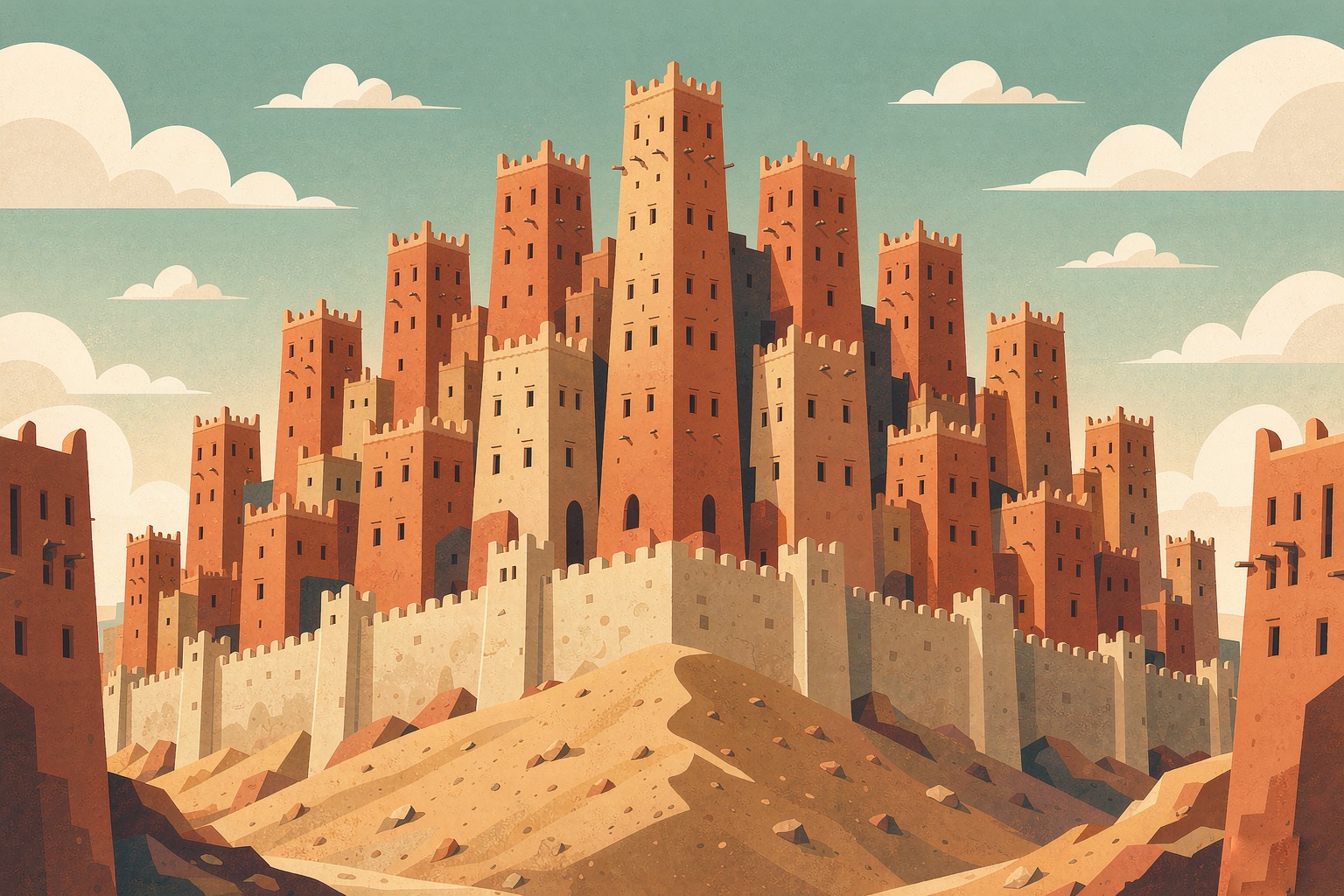
In a dry valley of the Hadramaut in southern Yemen there is a town that solved a problem in the 16th century which city planners are still arguing about now: how to fit a growing population inside a defensible wall.
Shibam built upward. Some 500 tower houses, packed shoulder to shoulder inside a mud-brick wall, climb to five storeys as a matter of course; the tallest reach seven or eight floors, around 30 metres — skyscrapers made of earth, five centuries before steel.
UNESCO inscribed the Old Walled City in 1982 (site 192), calling it “a masterpiece of urban planning based on the principle of vertical construction”.
A grid of shade
The towers are not a picturesque accident. The entire town is a passive cooling system:
- Narrow streets keep the walls in shadow for most of the day.
- Thick mud-brick walls hold the cool of the night well into the afternoon.
- Closely packed houses shade one another, so no single wall takes the full sun.
- Courtyards and wind openings pull air through the rooms.
The upper floors are living quarters; the ground floor is storage and animals, the heat and smell kept at the bottom of the stack. Rain is rare but violent — after it, the mud-and-straw plaster is renewed by the household, a maintenance cycle as old as the town.
Vertical living, 500 years ago
A tower house is a whole social unit. Rooms on each floor serve a different purpose, with a shared staircase and small windows high on the walls. The result is an extraordinary density: an urban population inside a walled oasis town, farming the palm groves outside and trading along the Hadramaut’s caravan routes.
Early Western visitors called it the “Manhattan of the desert” — a lazy comparison, since the logic is the opposite. Manhattan went up because land was expensive; Shibam went up because the arable land and the water were scarce and the walls fixed the footprint.
The honest note
Shibam is on UNESCO’s List of World Heritage in Danger. Flash floods and decades of conflict have damaged towers, and the Yemeni government advises against travel — as do Western governments without exception.
There is no responsible tourism itinerary to Shibam right now. What you can do is read UNESCO’s documentation, follow the conservation reports, and understand why the town matters: it is proof that dense, low-carbon desert architecture is not a modern invention but a five-hundred-year-old working solution.
Frequently asked questions
How can mud-brick houses survive 500 years in the desert?
The walls are thick load-bearing mud brick, plastered with a mud-and-straw render that is renewed after the rare rains. Shibam's.grid — narrow lanes and closely packed towers — shades the walls from the worst of the sun; each house is effectively shaded by its neighbours.
How many tower houses are there?
UNESCO's file counts some 500 tower houses inside the walled town, most of them two to five storeys, with the tallest reaching seven or eight floors and about 30 metres. Shibam was nicknamed 'Manhattan of the desert' by early travellers for exactly this reason.
Can I visit?
Not as a tourist at present. Travel to Yemen is advised against by most governments and there is no normal tourist access. Shibam is on the World Heritage in Danger list; the guide exists so the place is not forgotten, not as an itinerary.