Destinations · Yemen
Sana'a: The City That Has Looked Like This for a Thousand Years
Yemen's capital is one of the oldest continuously inhabited cities on Earth, more than 6,000 tower houses decorated with painted gypsum. A UNESCO site since 1986 — and a hard one to visit honestly.
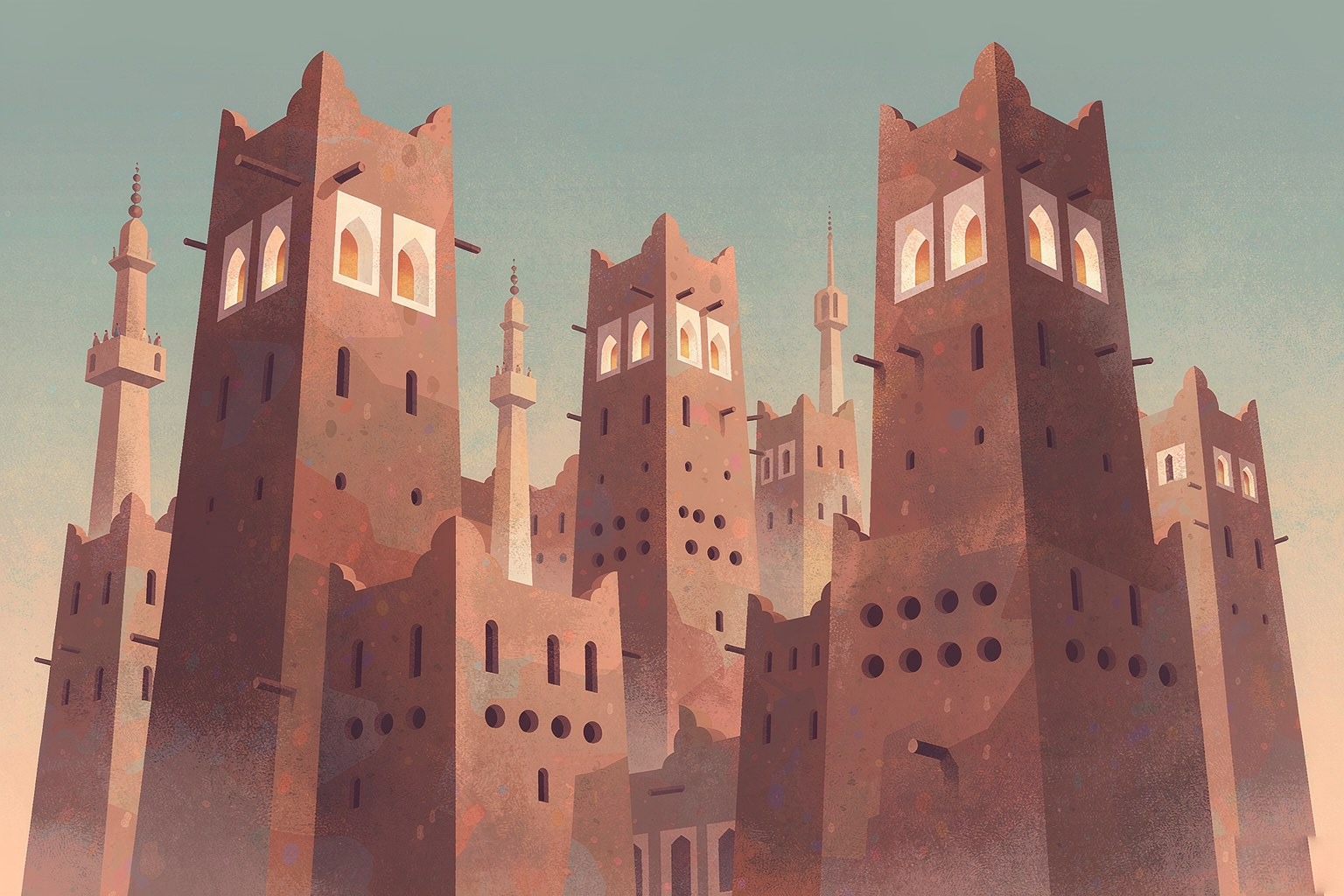
Some cities accumulate history. Sana’a never seems to have stopped living in it.
The Old City of Yemen’s capital has been continuously inhabited for more than 2,500 years — by tradition it was founded by Shem, son of Noah — and UNESCO inscribed it in 1986 (site 385) as one of the world’s oldest cities still doing its original job: housing people, densely, in the centre.
A skyline built upward
What strikes you first — in photographs, in memory — is the verticality. More than 6,000 houses built before the 11th century rise several storeys out of the valley floor, mud brick above cut stone, closing ranks around lanes that barely admit a cart.
The details are the signature:
- Qamariya windows — small fan-shaped windows of coloured glass set in white gypsum tracery, glowing like lanterns at dusk.
- Painted gypsum bands around the upper storeys, part ornament, part weatherproofing, each house’s patterns a kind of family signature.
- The mafraj, the top-floor reception room where guests take qat and the view — the best light in the house, given away to visitors. Hospitality built into the architecture.
Living heritage, literally
Unlike most listed old towns, Sana’a’s Old City is not a monument district. The mosques — including the Great Mosque, rebuilt in the 8th century — the hammams, the 6,000 houses and the suqs all still serve the community that lives there. UNESCO’s citation praises it as an unusually complete example of an Islamic city whose fabric and whose life survived together.
That completeness is also why the damage since 2015 has mattered so much. The Old City was moved to the List of World Heritage in Danger the same year; storms and conflict have brought down some tower houses, and rebuilding traditional techniques is itself now part of the conservation effort.
The honest travel note
This is the rare article on this site that must end with a warning instead of a route: most governments advise against all travel to Yemen, and the UK’s advice is no exception. There is currently no realistic tourist access to Sana’a.
So why write about it? Because the Old City is the clearest example in the region of what UNESCO listing is for — not tourism marketing, but a record that a place exists, is extraordinary, and is worth protecting even while its visitors stay away. Read the site’s own documentation. Watch the conservators’ reports. And keep Sana’a in the part of your travel imagination marked “when it becomes possible again”.
Frequently asked questions
Can tourists visit Sana'a?
Practically no, for now. Most Western governments, including the UK, advise against all travel to Yemen. The Old City is intact and its people are living in it, but the honest framing is: this is a place to read about and watch for, not to plan around, until the security picture fundamentally changes.
What makes Sana'a's architecture unique?
Density and height. Houses were built upward in mud brick and stone — some six storeys or more — with a reception room (mafraj) at the top for light and views. The white painted gypsum bands around the small windows work both as decoration and as rain protection, and each house's decoration was traditionally a signature of its owner.
Why is the Old City on the endangered list?
UNESCO placed it on the List of World Heritage in Danger in 2015, citing the conflict then raging in Yemen. Rain and conflict damage have since collapsed some tower houses, and conservation work continues under very difficult conditions.