Destinations · Turkmenistan
Merv: The Forgotten Capital That Was Once the Largest City in the World
In the 12th century, Merv in Turkmenistan may have been the biggest city on Earth. Today its ruins stand in the desert, empty. What happened, and why it is worth the detour.
For a few decades around 1150, if you asked a merchant where the greatest concentration of people on Earth lived, the honest answer was not Constantinople, not Baghdad, not Chang’an.
It was Merv, in the oasis of the Murghab river, in what is now Turkmenistan.
Five cities in one
UNESCO’s inscription of Merv (1999) is unusual because the site is not one city but five, layered side by side — a 1,200-hectare record of urban life running continuously from the 6th century BC to the 18th century:
- Erk Kala — the Achaemenid fortress, a circular earthen rampart you can still walk.
- Gyaur Kala — the Hellenistic-Selucid city, later a Sassanian and early Islamic capital.
- Sultan Kala — the Seljuk metropolis of the 11th–12th centuries, when the population estimates climb towards the top of the medieval range.
- Abdullah Khan Kala and Bayram Ali Khan Kala — the Timurid and later towns, with 15th-century walls still standing their full height in places.
Few sites anywhere show the full arc of Central Asian urbanism in a single view. At Merv you stand on the rampart of a Persian satrapy and look across at the walls of a khanate.
The dome that was the ceiling of the world
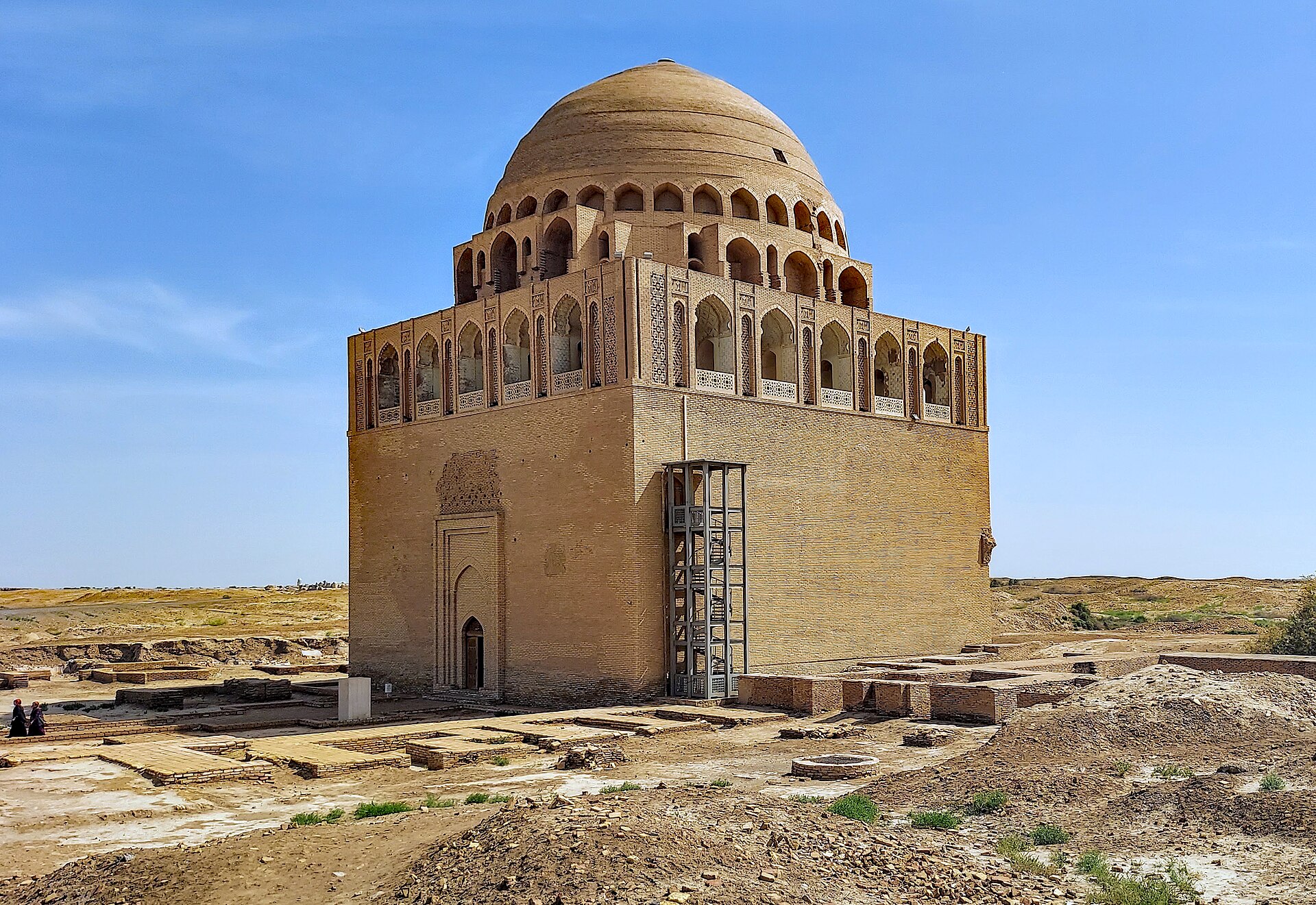
The building that justifies the trip alone is the mausoleum of Sultan Sanjar (c. 1157). Its dome, about 38 metres across in a single chamber, was said by contemporaries to be visible a day’s march away across the steppe — a landmark for caravans, and a technical claim that the Seljuks had out-domed everyone.
After centuries of earthquake damage and a Soviet-era partial reconstruction, it still holds the skyline of the empty city. On a flat desert site with no other verticals, you feel exactly what the caravaneers felt.
The library, and the end
Merv’s intellectual peak came under the Seljuks, when the city’s libraries were counted among the largest in the world and the astronomer Omar Khayyam worked here on calendar reform. Al-Sam’ani, one of medieval Islam’s great biographers, was Merv-born.
The end is famous and grim: in 1221 the Mongol army under Tolui took the city and, by the chroniclers’ accounts, dismantled it with a thoroughness rare even by the standards of the Mongol conquests. Population figures from the sources (into the hundreds of thousands killed) are debated, but the city’s decline into a minor Timurid shadow is not. Its water system — a lattice of canals on a silt-heavy river — required more labour to maintain than the shrunken population could give, and the oasis eventually let the cities go.
Visiting today
- The park is quiet. Most days you share it with a caretaker and the wind. The museum in Mary is excellent and provides the context (and the waterpipes, coins and stucco) that the open site can’t.
- Access to Turkmenistan is the real barrier. A five-day transit visa with fixed entry dates is the budget route; otherwise go with a licensed operator. Either way, Merv is a first-rank reason to make the effort.
- Combine it with Kunya-Urgench in the north (also UNESCO) for a two-site survey of the medieval cities of the Karakum’s edge.
Merv is the standing answer to a question people rarely ask: what does a world capital look like after eight hundred years of nobody?
Frequently asked questions
Where is Merv and how do I get there?
Merv lies about 30 km east of Mary, in southern Turkmenistan near the Afghan border. Fly or take the train to Mary, then a taxi to the archaeological park. Visa arrangements are the main hurdle — most visitors come on a pre-arranged tour or a transit visa with fixed dates.
What is left to see at Merv?
Five walled cities stacked side by side across 1,200 hectares: Erk Kala (6th century BC), Gyaur Kala, Sultan Kala with the mausoleum of Sultan Sanjar, and later suburbs. The Sanjar mausoleum's 38-metre dome was a wonder of its age and is restored to stand today.
Why did Merv disappear?
It was sacked by the Mongols in 1221, recovered partially in the Timurid era, and finally lost its water when the marginal canals of the Murghab river silted and shifted. The population moved to new foundations; the old cities were left as a shell in the desert.