Destinations · Saudi Arabia
At-Turaif: The Mud-Brick Capital a Kingdom Built and Lost
On the edge of Riyadh, the restored mud-brick district of At-Turaif was the first capital of the Saudi state — and a centre of religious reform — until an Ottoman army levelled it in 1818.
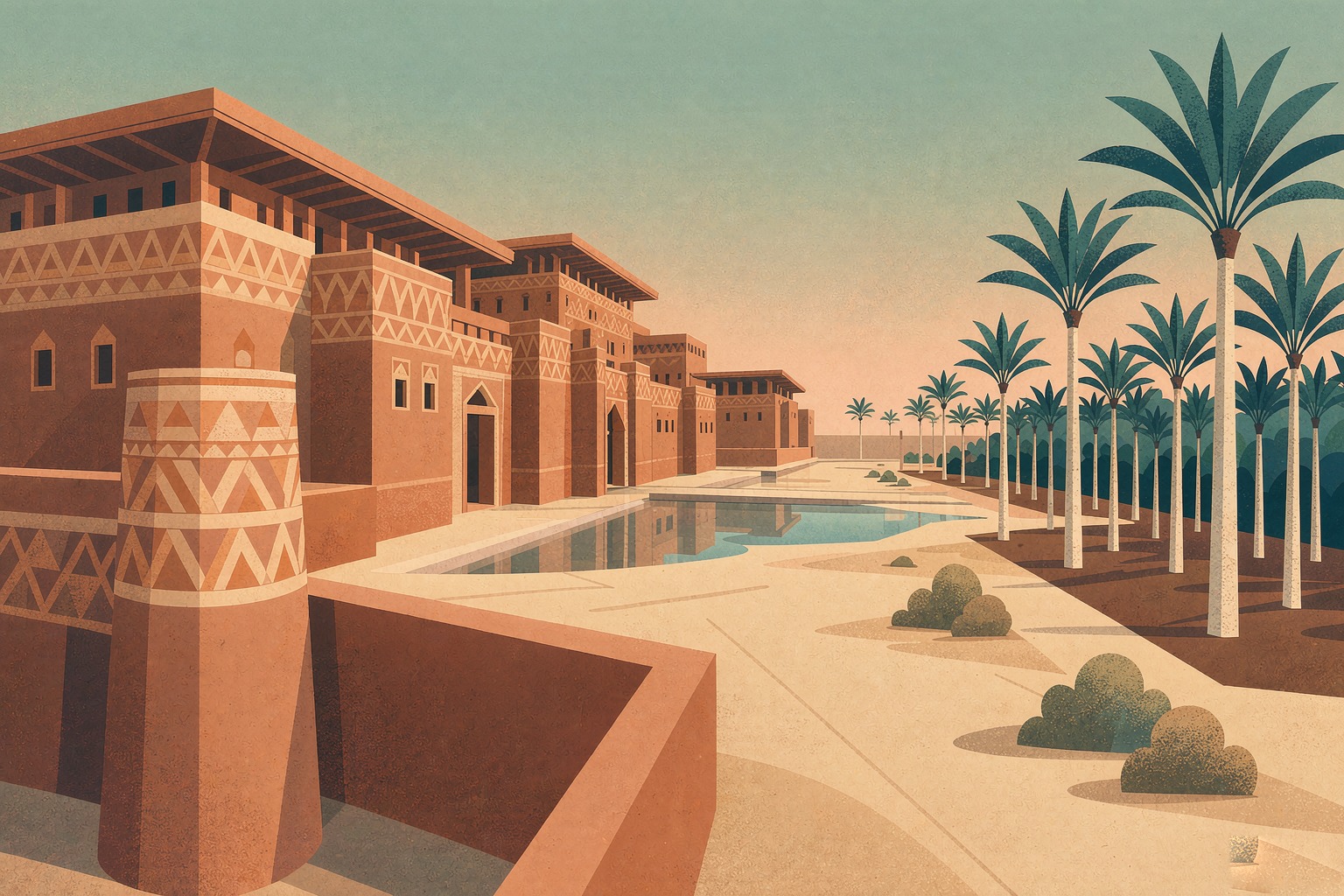
Twenty minutes northwest of Riyadh’s towers and traffic, a low City of mud brick sits in a wadi. It looks small from a distance. It was once the capital of a state that reached from the Arabian interior to the Hijaz and beyond — and the place where a religious movement that reshaped the region was preached and protected.
At-Turaif in ad-Dir’iyah became Saudi Arabia’s first UNESCO World Heritage site in 2010 (number 1329), described as an exceptional example of Najdi architecture and of a desert oasis capital.
A capital in mud
At-Turaif is not a single palace but a district: several great palace complexes, a mosque, houses and defensive walls made of mud brick, sun-dried and rendered. The largest, the Salwa Palace, was the seat of the Saudi family and the administrative heart of the First Saudi State.
Najdi architecture is built for this landscape:
- Thick mud-brick walls that resist the heat and the cold of the interior plateau.
- Triangular and geometric motifs cut into the plaster — a decorative vocabulary distinct from the tilework of Iran or the gypsum of Yemen.
- Courtyard houses turned inward for privacy and shade, with towers for defence.
UNESCO’s citation singles out the “exceptional quality” of the mud-brick building tradition here — a whole school of architecture developed in an environment with almost no timber and very little stone.
The price of being a capital
In the late 18th century Diriyah became the centre of the reform movement led by Muhammad ibn Abd al-Wahhab under the protection of the Saudi rulers. That alliance made the town both a political and a religious target, and in 1818 an Ottoman-Egyptian army took and dismantled it. The state was destroyed, the palaces abandoned, and the site slowly disappeared into the ground.
What you see today is a carefully documented reconstruction — a major point to be honest about. The walls were rebuilt using traditional materials and techniques based on archaeological remains and historical accounts. It is a restored site, not an untouched ruin, and the interpretation is open about that.
Visiting
Ad-Dir’iyah is now the centrepiece of a large heritage development: the restored district, a visitor centre, a museum, and a traditional market. Allow two to three hours for the site itself, more if you take a guided tour of the restored palaces.
Combined with a day in central Riyadh — the National Museum and the old market — it makes a straightforward introduction to the part of Arabia most visitors historically skipped.
Frequently asked questions
How close is At-Turaif to Riyadh?
About 20 km northwest of central Riyadh, in the town of ad-Dir'iyah — an easy half-day trip. It is the closest World Heritage site to the Saudi capital and now the anchor of a large restoration district.
Why was Diriyah destroyed?
The First Saudi State, with Diriyah as its capital, was brought down by an Ottoman-Egyptian campaign led by Muhammad Ali Pasha's forces; the city was taken and largely destroyed in 1818. The mud-brick fabric could not survive a siege and deliberate demolition.
What does the architecture show?
Najdi mud-brick: massive fortified palaces, triangular and geometric decoration cut into the mud plaster, and courtyard houses adapted to a hot, dry wadi. UNESCO cites it as the outstanding surviving example of the architecture of central Arabia.