Culture · Saudi Arabia
Khawlani Coffee: Three Hundred Years of Beans on a Mountainside
In Saudi Arabia's Jazan mountains, Khawlani tribes have grown coffee on stone terraces for over 300 years. UNESCO listed the practice in 2022 — and the beans are finally reaching the world.
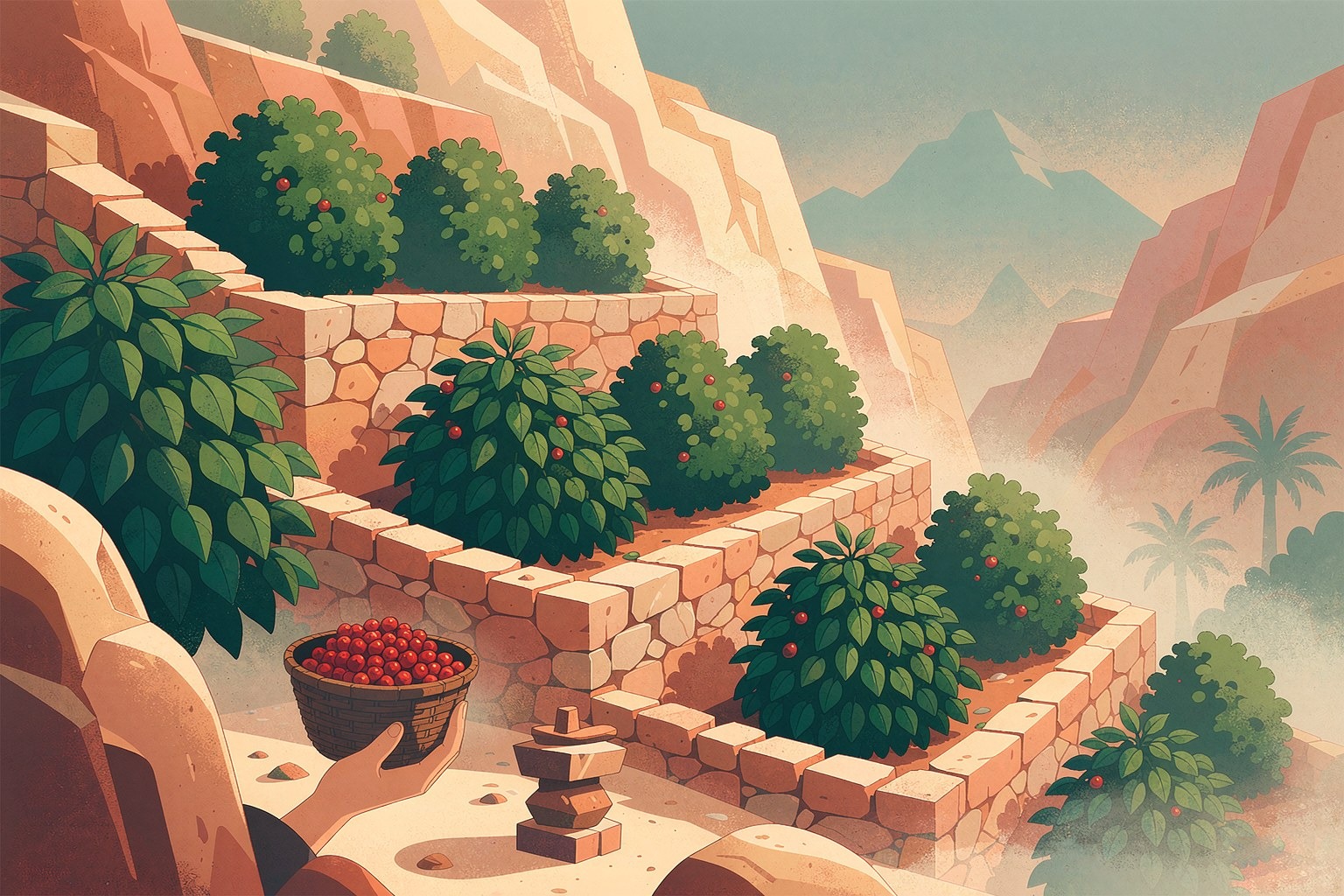
The world drinks coffee from a belt around the equator, and the southwestern corner of Saudi Arabia sits inside it. On the terraced mountains of Jazan, the Khawlani tribe has cultivated coffee for more than 300 years — long enough that the beans carry the tribe’s name, and long enough that UNESCO listed the entire growing practice in 2022 (element 01863).
The terrace system is the heritage
What UNESCO protects is not a recipe but a landscape and its knowledge. Seeds start in mesh bags in the shade for three or four months, then move to agricultural terraces built to conserve water and soil on steep slopes. The fruit takes two to three years to first harvest, is picked by hand, dried in the sun, and hulled on a flat stone mill turned by a cylindrical stone — a method designed to separate the bean without cracking it.
Every step is transmitted the old way: farmers gather between farms and seasons to exchange techniques and help each other improve. The UNESCO file treats that mutual-aid structure as part of the element, not a footnote to it.
Coffee as a currency of honour
In Saudi hospitality, coffee is generosity made drinkable — and the Khawlani file says it plainly: serving guests coffee from beans harvested on your own farm is considered a sign of honour and respect. In the mountains, the coffee you offer is a biography of your land and your year.
Tasting your way in
The practical routes in:
- Al-Dayer hosts an annual Khawlani coffee festival that has grown into the region’s showcase for beans, roasting styles and the farmers themselves.
- Saudi specialty roasters in Riyadh and Jeddah now bottle the provenance — look for “Khawlani” on the label.
- The traditional service is qahwa: lightly roasted, ground with cardamom (saffron on occasions), poured from the dallah in small cups — the same gesture described in our Arabic coffee piece, now with a mountain-grown bean behind it.
Three centuries of terraces, one hillside, and a bean that is only now becoming known beyond the mountains that grew it.
Frequently asked questions
Where does Khawlani coffee grow?
In the Jazan region of southwest Saudi Arabia, on terraced mountain slopes around Al-Dayer governorate — part of the Sarawat range where Saudi Arabia, with coffee-friendly altitude and mist, touches the Yemeni coffee belt.
What does it taste like?
Producers and the UNESCO file emphasise aromatic, fruity profiles; the beans are often roasted and ground with cardamom and saffron for the Saudi qahwa service. Look for the Khawlani designation at Saudi specialty roasters and the annual coffee festival in Al-Dayer.
Why did UNESCO list coffee farming?
Element 01863 protects the whole knowledge system — terrace building that conserves water and soil, seed selection, hand harvest, stone-mill processing — and its social role: farmers gather to exchange skills, and serving coffee from your own farm is a mark of honour to guests.