Crafts · Iran, Syria
The Oud: Twenty-Five Days to Build an Instrument Older Than Its Name
The pear-shaped lute at the root of Middle Eastern music takes up to 25 days to build. Iran and Syria got the craft onto UNESCO's list in 2022 — here is how an oud is actually made.
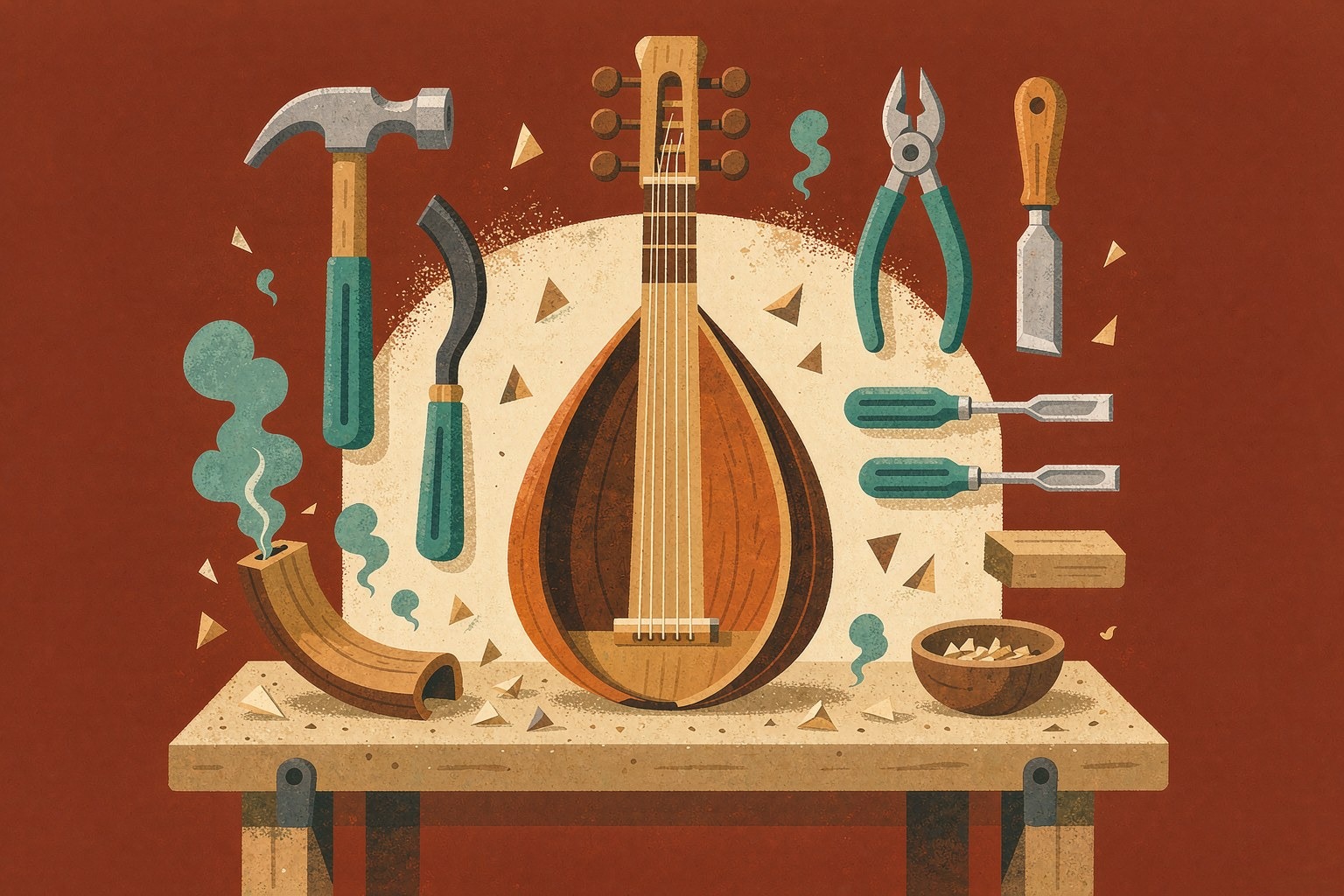
Strip the amplified orchestra away from almost any piece of Middle Eastern music and the instrument underneath is usually the same one: a fat, pear-shaped, fretless lute called the oud — the word that gave English “lute” by way of Arabic al-‘ud, “the wood”.
UNESCO inscribed its craft in 2022 (element 01867) as a joint nomination from Iran and Syria, and the file reads like a carpenter’s manual crossed with a family album.
What the wood wants
An oud’s bowl is built from narrow ribs — walnut, rosewood, poplar, ebony or apricot — bent and glued edge to edge, which is why the instrument takes up to twenty-five days to make. A large share of that time is not work at all but patience: the wood is steamed and soaked repeatedly over roughly fifteen days so it can take the curve without splitting.
The result is an instrument with no frets and, typically, five courses of double strings (six is a modern addition). Fretless is the whole point: the player’s finger lands wherever the mode requires, including the quarter-tones a guitar physically cannot produce.
A craft with addresses
The UNESCO decision notes where the tradition lives:
- In Iran: Khuzestan, Bushehr and Hormozgan in the south, Kurdistan in the west, plus workshops and teaching studios in Tehran and Shiraz.
- In Syria: Damascus and Aleppo as the historic centres of making, with players everywhere — the oud was, traditionally, part of a bride’s dowry.
Crafting has been mostly a male trade; playing never was. And in recent years the UNESCO file observes a small reversal — young women have begun taking up the making as well as the music.
What to listen for
The oud plays melody and drone at once, its thick bass strings ringing under the tune like a second, quieter instrument. It is the backbone of the maqam system in the Arab world and at home in Persian dastgah; solo, it carries the taqsim — the free, searching improvisation that opens a performance and finds the room’s mood before any song begins.
If you take one listening tip with you: wait for the moment the player stops and lets a note decay into silence. That hollow, woody fading is the sound twenty-five days of carpentry was built to make.
Frequently asked questions
Why does the oud have no frets?
A fretless neck lets the player land notes between the piano's keys — the quarter-tones and slides that define Arabic and Persian modal music (maqam and dastgah). It makes the instrument harder to learn and infinitely more expressive.
How long does it take to craft an oud?
UNESCO's file says up to twenty-five days. Much of that is waiting: the wood must season and harden, then undergo repeated steaming and soaking over about fifteen days to bend the ribs of the bowl without cracking them.
Where can a traveller hear one?
Look for live maqam or dastgah evenings rather than tourist dinner shows: Damascus and Aleppo have historically been the craft's Syrian centres, while in Iran the tradition is strong in Khuzestan, Bushehr, Hormozgan and Kurdistan — and in tea houses and music cafes in Tehran and Shiraz.